Accept Digitized Records with Confidence
A digitized record can look acceptable on screen while failing the quality requirements needed for access, preservation, or contractual acceptance. This becomes especially important when a project involves multiple scanners, operators, locations, or external digitization providers. Small variations in equipment, capture settings and workflows can affect image quality. They can also make acceptance decisions less straightforward.
The question is simple: can you demonstrate that the delivered material meets the agreed quality requirements?
A structured and measurable quality control process gives organizations a clear basis for accepting digitized records, identifying deviations and reducing costly rescanning or rework.
1) Are the digitized records legible?
For digitized records to be useful, the information in the original must remain readable in the digital form.
This is not always easy to assess. Historical and public records may contain faded text, fine details, annotations, stamps, photographs, colored elements, or uneven backgrounds. Capture settings can affectt how accurately these features are reproduced.
Issues around sharpness, exposure, contrast, resolution, or color reproduction are not always immediately visible. They may only become apparent when files are enlarged, processed, searched or accessed later.
Visual inspection remains valuable, but it becomes more difficult to apply consistently as project volumes grow. Different reviewers can interpret acceptable quality differently. This can result in inconsistent decisions, rejected batches and weak audit evidence.
2) Is image quality consistent throughout the project?
A small sample of good images does not necessarily mean that quality is consistent across an entire digitization project.
Results can vary between scanners, operators, locations, shifts, batches and external providers. Even when the same material is scanned, changes in settings, calibration or equipment performance can influence the outcome.
To achieve repeatable results, organizations need a defined quality baseline against which capture performance can be assessed.
Standards and guidelines such as ISO 19264 1 and FADGI provide measurable criteria for evaluating image quality. They enable organizations to move beyond visual judgement and assess whether their capture environment continues to meet the required quality level.
3) Are your acceptance criteria documented and measurable?
Terms such as high quality scanning can be interpreted differently by everyone involved in a project.
Documented and measurable acceptance criteria create a shared understanding of what is required. Depending on the source material and intended use, these may include resolution, sharpness, color accuracy, geometry, noise, illumination and tonal respone.
For example, a project focused on online access may have different requirements from one intended for long term preservation.
Clear criteria support quality checks, supplier evaluation and decisions about whether records need to be rescanned. They turn acceptance requirements into a consistent and repeatable process.
4) Can you verify that suppliers meet the agreed requirements?
Outsourcing digitization does not remove the need for quality control.
When receiving digital records from an external provider, organizations need confidence that the delivery meets the requirements agreed at the start of the project. A documented quality baseline gives both parties a common point of reference.
Suppliers know what is expected. Organizations have an objective basis for deciding whether a delivery can be accepted.
This helps reduce ambiguity, avoid unnecessary rework and build a more efficient relationship with digitization partners.
5) Is quality control documented?
It is not enough to state that quality has been checked. Organizations also need to understand how it was assessed.
A structured quality control process records what was measured, which criteria were applied, whether requirements were met and how deviations were handled. This documentation is particularly valuable when multiple parties are involved or when collections need to be reviewed in the future.
It provides clear evidence to support acceptance decisions.
- From visual inspection to measurable quality control
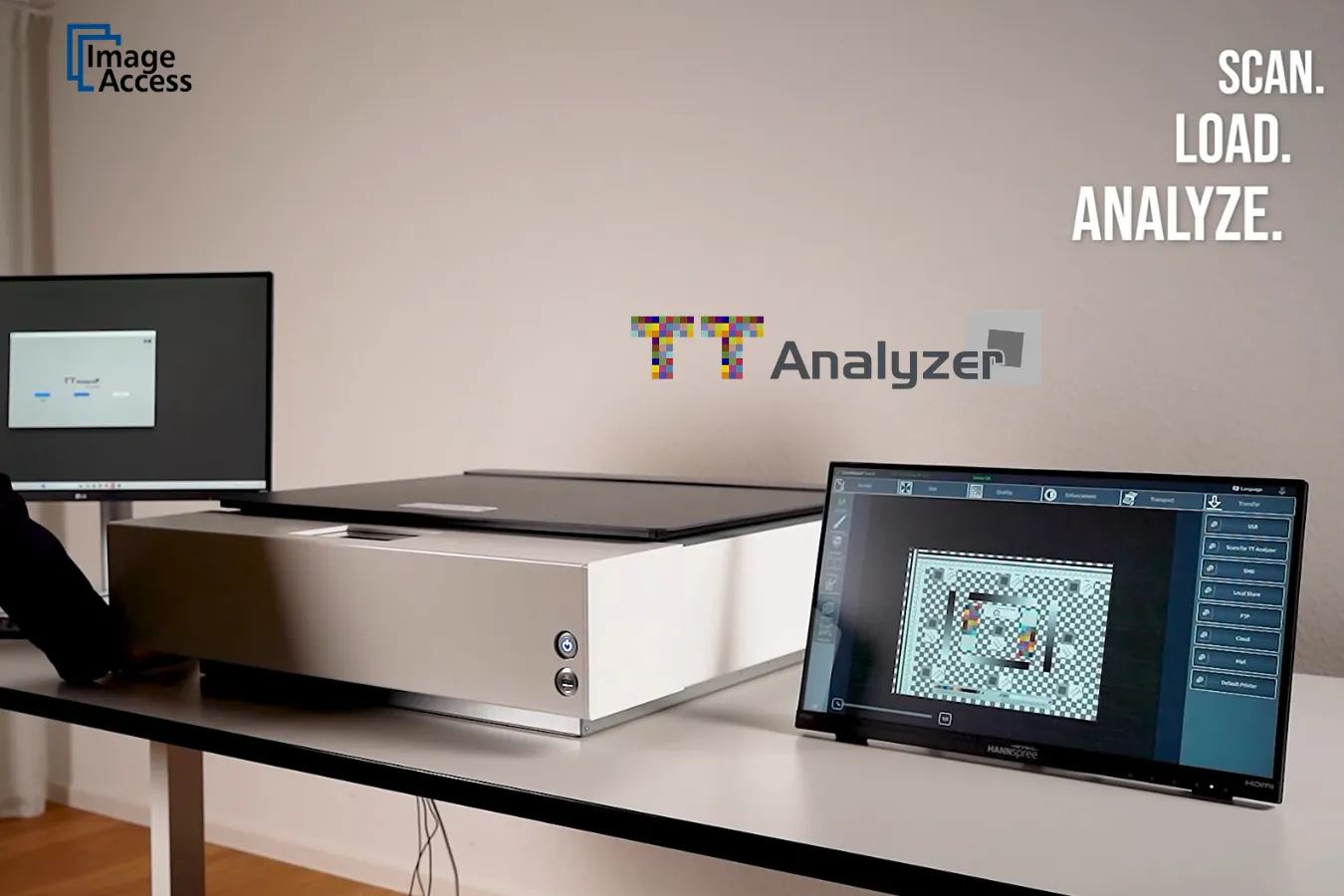
TT Analyze by Image Access is a tool designed to organizations turn scan quality requirements into a practical and repeatable acceptance process.
Using standardized targets and selected ISO 19264 1 or FADGI criteria, TT Analyzer measures image quality and provides clear visual feedback. This makes it easier to see where requirements are being met and where attention is needed.
Detailed measurement data remains available users who require more in depth analysis.
The workflow is simple:
Measure → evaluate → optimize → verify
By establishing a consistent quality baseline, organizations can assess results across scanners, operators, locations and external digitization providers with greater confidence.
- Create documented evidence of scan quality
TT Analyzer by Image Access can generate a certificate or report that documents the selected quality criteria, source file, scanner identification and evaluation points that passed the assessment.
This provides a clear record of the quality-control process and supports more consistent acceptance decisions across projects and partners.
TT Analyzer is one part of the broader digitization environment. It supports scan-quality control. It does not replace archival systems, records management, secure storage, access controls, or digital preservation workflows.
- Establish a clearer acceptance process
With TT Analyzer, organizations can measure scan quality against defined criteria, create documented evidence and establish a consistent basis for accepting digitized material.
Talk to the Dyanix team to explore how TT Analyzer by Image Access can support your digitization and quality control requirements.
Ready to digitize your documents?
Our experts are here to help you choose the right scanner and services that fit your business needs.